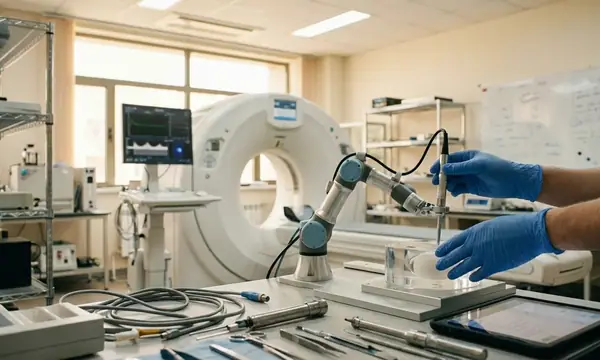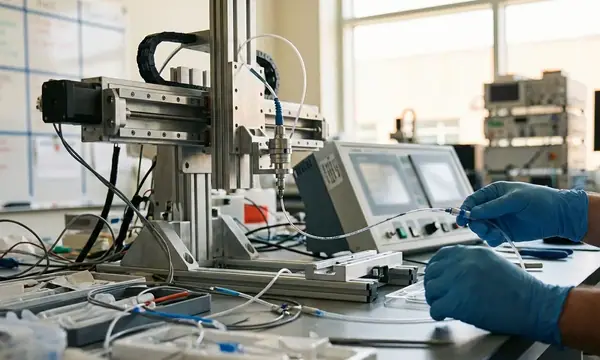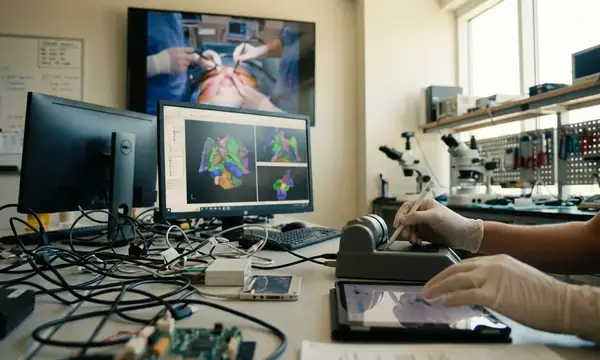
Level 4 autonomous surgery addresses a control problem that teleoperation cannot solve through faster networking alone. During a bounded surgical sub-task, the robot closes the action loop locally while the surgeon supervises task state and retains override authority. That distinction changes how researchers should design motion planners, evaluate latency, and structure certification evidence.
Table of Contents
- Defining the Threshold: What Constitutes Level 4 Autonomous Surgery
- The Physical and Network Limits of Master-Slave Teleoperation
- Algorithmic Foundations for Supervised Surgical Autonomy
- Navigating the Ethical and Technical Roadmap for Certification
- The Imperative to Shift Research Focus Toward Sub-Task Autonomy
Defining the Threshold: What Constitutes Level 4 Autonomous Surgery
The decisive question is simple: who closes the action loop during the surgical sub-task? A Level 4 system perceives task state, selects instrument motion, and executes a specified complex sub-task without continuous commands from the surgeon. The surgeon remains responsible for supervision and can intervene when the robot reaches an abort condition or leaves its validated operating envelope.
Level 0 and Level 1 systems keep that loop at the master console. Each meaningful instrument movement originates with the surgeon through direct, continuous control, even when the platform provides motion scaling, filtering, or limited assistance. Level 4 transfers a carefully bounded portion of the loop to algorithmic control.
| Control level | Source of instrument motion | Surgeon’s role |
|---|---|---|
| Level 0 | Continuous commands from the master console | Direct control throughout the task |
| Level 1 | Continuous surgeon commands with limited robotic assistance | Direct control with supporting automation |
| Level 4 | Local perception, planning, and control within a bounded sub-task | Supervision, task authorization, and intervention |
A credible Level 4 specification names the anatomical target, permitted tool-tissue contacts, force and workspace constraints, completion criteria, abort conditions, and return state after interruption. Following a declared suture line, maintaining retraction within a force envelope, or positioning a camera to preserve a specified field of view can meet this definition. Treating an entire operation as one autonomous task would erase the boundaries required for validation.
Bound the Task
Level 4 autonomy applies inside a validated sub-task and operating envelope. It does not imply autonomous management of an unmodeled complication or an entire procedure.
The Physical and Network Limits of Master-Slave Teleoperation
Communication delay accumulates across the full control path: console sampling, command encoding, transport, decoding, actuator response, image capture, video compression, and return transmission. Optimizing one stage may leave the round trip perceptibly slow during delicate contact.
Delays are commonly cited in the 100–200 millisecond range as noticeable during precise manipulation. Delays recorded around 300–500 milliseconds can provoke move-and-wait behavior, overshoot, and oscillatory correction during demanding teleoperation tasks. Motion speed, prediction aids, visual feedback, and tissue compliance shift the practical boundary. Low average delay also gives incomplete reassurance when jitter introduces stale frames or command bursts during tool-tissue contact.
Long procedures expose a second constraint. For operations with durations estimated at two to four hours, evaluation should compare early and late segments using path length, velocity reversals, idle time, clutch use, corrective motion, and deviation from the intended trajectory. Procedure duration alone cannot reveal declining kinematic efficiency or changes in decision quality associated with fatigue.
These mechanisms create a ceiling for conventional master-slave control. A faster link can improve responsiveness, yet every incremental tool command still depends on a remote round trip. The more useful research question is whether contact stabilization can continue safely when the supervisory connection becomes delayed or irregular.
Test the Jitter
Latency experiments should introduce delay variation and packet loss during contact. A stable average can conceal the transient network behavior most likely to disturb precise manipulation.
Algorithmic Foundations for Supervised Surgical Autonomy
The control stack should be designed from the contact interface outward. Engineers first define acceptable tool-tissue interaction, then select sensing that estimates those variables, construct a deformation-aware state representation, and plan motion under kinodynamic constraints. This ordering keeps the safety argument tied to physical behavior rather than endpoint geometry alone.
A Multirate Control Stack
A practical architecture may run joint or force control at 500–1,000 hertz, visual estimation at 30–60 frames per second, and deformation-aware trajectory updates at approximately 5–20 hertz. These ranges describe engineering practice, not universal certification thresholds. High-bandwidth contact control stays close to the robot, while slower perception and planning layers revise the intended trajectory as anatomy moves.
- Suturing: Track the needle, grasper, entry and exit regions, thread configuration, and local tissue motion.
- Retraction: Monitor sustained load, slip, occlusion, and movement of the exposed anatomical field.
- Supervision: Transmit task commands, state, video, confidence information, and override signals rather than every incremental joint command.
Local closed-loop control mitigates latency because the robot-side controller computes stabilization and micro-adjustments within milliseconds. The surgeon supervises the task at a higher level and intervenes when constraints activate, confidence deteriorates, or progress no longer matches the declared plan.
Computer vision and force feedback must remain coupled. Vision estimates anatomy, tool pose, and deformation; force sensing constrains contact that may be ambiguous or hidden in the image. A suturing policy can place the needle correctly and still create a hazardous slack loop around an instrument. Endpoint accuracy therefore supplies only one part of the safety evidence.
Asymptotic optimality remains relevant when comparing motion-planning methods, but surgical execution imposes finite computation deadlines and evolving contact constraints. A planner gains practical value when it returns a safe, dynamically feasible update before the current state estimate becomes stale.
Navigating the Ethical and Technical Roadmap for Certification
Supervised autonomy offers a direct patient-safety rationale: it can delegate repetitive, high-precision actions that otherwise demand uninterrupted manual control during lengthy procedures. The ethical case depends on preserving surgeon authority and demonstrating that autonomous execution reduces exposure to fatigue-related degradation without creating opaque failure modes.
Traditional deterministic device testing provides an incomplete model for adaptive perception and planning. Certification evidence should instead be organized around hazards, state transitions, and recovery behavior. Relevant work on standards and frameworks for robotics autonomy can inform the vocabulary, while surgical systems still require task-specific evidence grounded in tissue interaction.
Separate Safety Outcomes
Validation should distinguish at least four outcomes:
- Successful autonomous completion
- Safe autonomous abort
- Successful surgeon takeover
- Hazardous continuation
Pooling these outcomes into one completion rate can hide the behavior that matters most. Tests should include partial camera occlusion, specular glare, blood or smoke obscuring landmarks, dropped image frames, force-sensor drift, actuator saturation, and tissue properties outside the training distribution.
Meaningful human control also requires a technically coherent handoff. The handoff record should preserve the active task phase, latest accepted perception state, commanded and measured tool pose, recent force history, confidence values, triggered constraints, and the reason autonomy stopped. The manual controller must inherit a comprehensible state rather than an unexplained instrument configuration.
Preserve Handoff State
A manual override is only useful when the surgeon can determine what the autonomous controller attempted, what constraint triggered, and which physical state remains active.
The Imperative to Shift Research Focus Toward Sub-Task Autonomy
Research priorities should be judged by one criterion: which capability remains useful when communication quality deteriorates? Local perception, deformation-aware planning, contact control, and safe abort logic continue to operate under that condition. Marginal reductions in console-to-robot latency do not remove dependence on the network.
A focused work package, estimated at 12–24 months, can target one bounded task and require staged evidence from benchtop phantoms, deformable or ex vivo models, and supervised preclinical evaluation. Milestones should report task duration, intervention count, abort cause, peak and sustained interaction force, trajectory error, perception-confidence loss, and recovery under added delay, jitter, packet loss, and sensor occlusion.
The useful autonomy boundary will shift with anatomy, tissue stiffness, tool geometry, imaging quality, and clinical phase. That variability argues for explicit operating envelopes and modular sub-tasks. A controller validated for regular needle driving cannot be presumed safe for friable tissue or active bleeding.
The scalable architecture is hierarchical: high-bandwidth safety and contact control remain local to the surgical robot, while remote experts select tasks, review state, and intervene when the system exits its validated envelope. This treats the robot as an intelligent surgical partner while preserving clear supervisory authority.
Academic laboratories and funding agencies should move resources from marginal teleoperation-latency gains into robust, physics-aware autonomous sub-task execution; Level 4 supervised autonomy is the viable technical path for scaling advanced surgical capability.