How can an autonomous system maintain real-time performance while calculating multimodal uncertainty across a high-dimensional configuration space? The answer begins inside the planner’s recurring control cycle: incorporate an observation, predict how candidate controls alter the belief, evaluate collision and task risk, and publish a command before the deadline. Non-Gaussian beliefs make each step more expressive and more expensive. Practical belief-space planning therefore hinges on preserving safety-relevant uncertainty while constraining computation.
Defining the Uncertainty Propagation Problem
Traditional formulations often represent uncertainty with a single Gaussian distribution. That representation stores one mean and one covariance, making prediction and observation updates comparatively compact. It becomes misleading when perception returns several distinct explanations for the same scene.
A single Gaussian centered between two plausible object poses may assign probability mass to an empty or obstructed region. A planner can then approve a trajectory that appears safe around the mean while intersecting either actual pose. Gaussian mixtures preserve these alternatives, but a mixture with M components requires M means, covariance representations, and weights. Prediction or observation updates may split those components again.
The Recurring Planning Cycle
For a 7-DOF arm modeled with joint position and velocity, the dynamic state already contains 14 dimensions. Object pose, calibration error, contact state, and sensor bias expand it further. Every planning branch must carry enough of this belief to estimate future observations and collision exposure. Accuracy favors richer representations; deadline compliance favors aggressive structure and selective computation.
The Computational Burden of Non-Gaussian Distributions
The burden separates into three operations: propagating hypotheses through nonlinear dynamics, updating their likelihoods from observations, and evaluating risk along candidate trajectories.
A dense covariance for an n-dimensional state contains n2 entries. Common factorization and inversion operations scale cubically with n unless the implementation exploits sparsity or other structure. Direct grids fare worse: a discretization with k values per coordinate contains kd cells. Ten values across 14 coordinates produce 100 trillion cells.
Particle representations avoid an explicit grid while shifting the cost elsewhere. Storing 10,000 particles over a 14-dimensional state in 64-bit floating-point values requires 1,120,000 bytes for state values alone. Weights, ancestry, map queries, and allocator overhead remain outside that figure.
These constraints matter for deployed autonomy. NASA programs must account for radiation-tolerant processors, power budgets, communication delay, and limited ground intervention. National Science Foundation robotics initiatives likewise emphasize scalable inference and planning in unstructured environments. NSF Grant CNS 0932423 provides historical funding context for related algorithmic robotics research rather than a blanket validation of any particular solver.
Benchmarking Current Solvers in High-Dimensional Spaces
A useful benchmark fixes the dynamics, sensor model, collision geometry, observation sequence, stopping rule, hardware thread count, and safety threshold. Solver rankings lose meaning when these conditions differ.
Qualitative comparison of non-Gaussian belief representations| Method | Primary Cost | Scaling Concern |
|---|---|---|
| Particle filter | Likelihood evaluation, normalization, resampling, and repeated risk queries | Memory grows approximately with particle count and state dimension; resampling may remove a narrow safety-critical mode |
| Gaussian mixture | Separate means, weights, and covariance operations for each mode | Mode splitting can make covariance storage the dominant allocation |
| Unscented propagation | Repeated model evaluation at deterministic sigma points | A standard transform uses 2n + 1 points, or 29 evaluations at n = 14, before branches or mixture modes |
A real-time test can impose a 50-millisecond planning cycle, corresponding to a 20-hertz control update. Reporting only average runtime conceals operational failures. The benchmark should separate belief-update time, tree expansion, and collision checking, then report deadline misses alongside median and tail latency.
Gaussian mixtures work well when a few persistent hypotheses explain the scene. Their cost rises sharply around occlusion boundaries and contact transitions, where components repeatedly split. Particle filters handle irregular distributions more naturally, yet temporarily uninformative observations can leave a low-weight, high-consequence mode vulnerable during resampling.
Algorithmic Strategies for Mitigating Bottlenecks
Begin with the uncertainty directions that influence collision probability or task success. Preserve those directions in a local subspace, factor weakly coupled variables, and retain separate modes only where merging would hide a consequential alternative.
Structured Representation
Low-rank covariance propagation replaces an n-by-n dense matrix with an n-by-r factor when uncertainty is concentrated in r directions. Storage falls from n2 values to nr values plus any retained diagonal term. The useful rank should follow task geometry rather than a fixed compression target.
Parallel and Adaptive Work
Particles, mixture components, candidate controls, and collision queries offer direct parallelism because they often share read-only dynamics and geometry. Adaptive sampling can then focus effort near obstacles, contacts, or ambiguous observations. Effective sample size provides a practical resampling signal; resampling every cycle wastes computation and accelerates sample impoverishment.
Deadline Protection: Combine task-aware dimensionality reduction, parallel hypothesis propagation, and adaptive sampling. Reserve the final portion of each 50-millisecond cycle for risk verification and command publication so belief-tree expansion cannot consume the complete control budget.Core Literature and Methodological References
The literature progresses from partial-observability theory to belief-space search, local optimization, and practical non-Gaussian estimation. The agency reference establishes the deployment context behind current work on scalable robotic autonomy.
Sources
- Kaelbling, L. P., Littman, M. L., and Cassandra, A. R. (1998). Planning and Acting in Partially Observable Stochastic Domains. Artificial Intelligence.
- Platt, R., Tedrake, R., Kaelbling, L. P., and Lozano-Perez, T. (2010). Belief Space Planning Assuming Maximum Likelihood Observations. Robotics: Science and Systems.
- Bry, A., and Roy, N. (2011). Rapidly-Exploring Random Belief Trees for Motion Planning Under Uncertainty. IEEE International Conference on Robotics and Automation.
- van den Berg, J., Patil, S., and Alterovitz, R. (2012). Motion Planning Under Uncertainty Using Iterative Local Optimization in Belief Space. The International Journal of Robotics Research.
- Thrun, S., Burgard, W., and Fox, D. (2005). Probabilistic Robotics. MIT Press.
- National Science Foundation (n.d.). Robotics Initiatives. Official agency program reference.
Field Application: Navigating Cluttered Environments
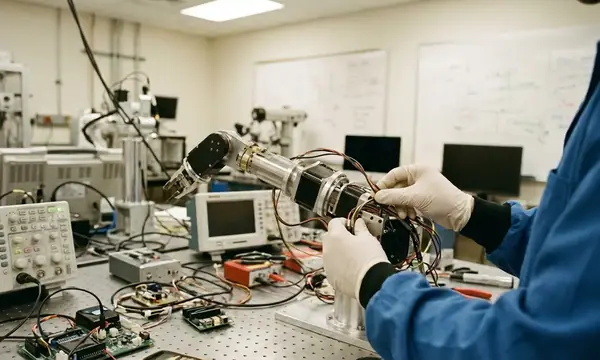
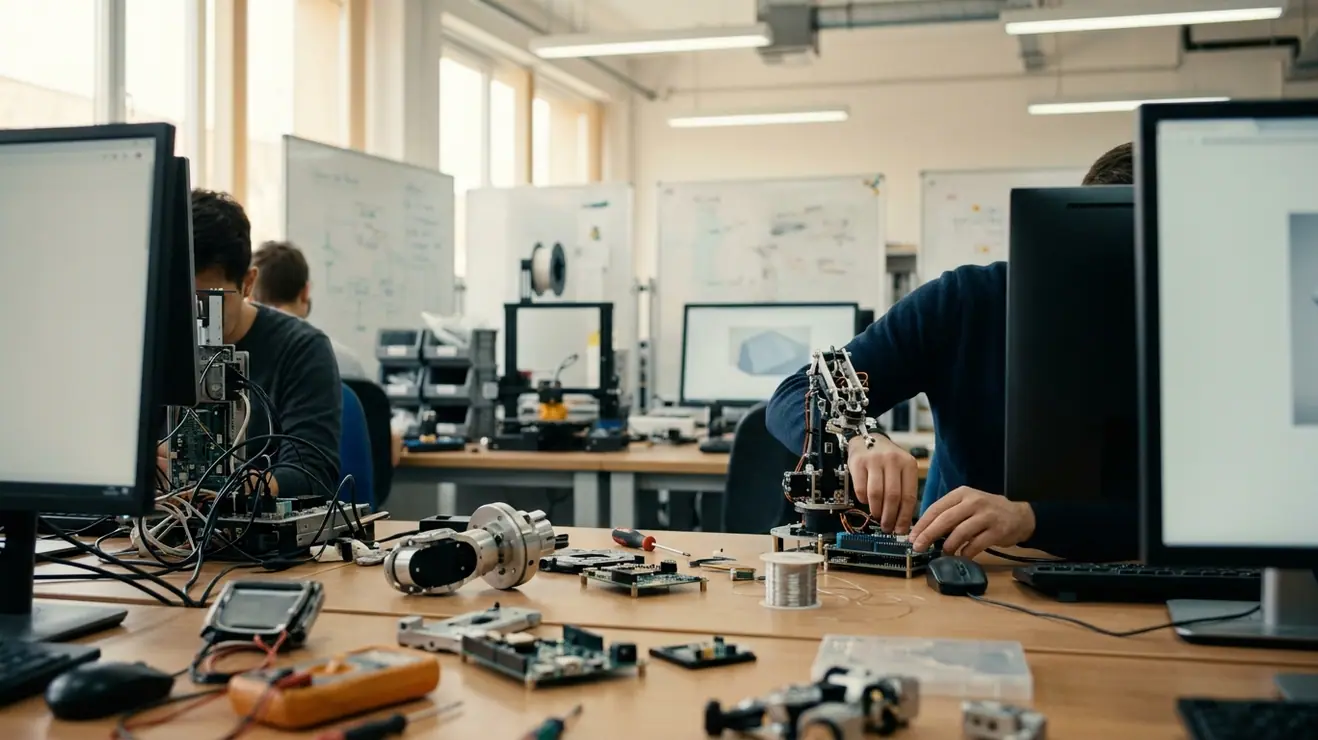
A 7-DOF manipulator waits beside a cluttered laboratory bench under dim illumination. Its perception stack returns several plausible object poses, each adding three translational and three rotational coordinates to the 14-dimensional joint state. Adjacent equipment leaves a narrow approach corridor.
Within one 50-millisecond cycle, parallel workers propagate the surviving pose modes while adaptive sampling concentrates near the object, gripper fingers, and tight clearance. The planner divides the approach into short trajectory intervals, checking swept links instead of testing only endpoint configurations. A final risk pass rejects the branch that clips the equipment under the less likely pose hypothesis.
The command reaches the arm at 20 hertz. Its wrist turns a few degrees, the elbow clears the bench fixture, and the gripper enters the corridor along the remaining collision-free trajectory. Under the weak overhead light, the fingers close around the object while the planner carries both plausible poses into the next update.